
Writing Rules
Author Guidelines
• The articles must be written in English.
• The manuscript is to be written in the WORD format.
• When submitting a manuscript, the author's information should not be included in the full text.
• The author(s) guarantee(s) that the manuscript itself or any substantially similar content of the manuscript has not been published or is being considered for publication elsewhere.
• If the study is a part of Master of PhD Thesis, the following description should be added: "This article is prepared from the Master's / Doctoral thesis titled "xxxxxx xxxxxxxxx xxxx" by xxxxxx XXXX under the title appropriate for articles produced from a thesis."
• Where available, URLs for the references must be provided.
• The manuscript must be prepared using the template in the link below.
• 1.15 line spacing and 11 point Calibri (body) style are used throughout the text. As margins, 2 cm space should be left at the top and bottom, and 2.5 cm on both sides..
• All illustrations, figures, and tables are placed within the text at the appropriate points, rather than at the end. All figures, graphics, photographs and tables are to be given in the main text where they are mentioned and transferred to the electronic medium. The figures, photographs, graphics should be presented in the JPG, or TIFF format.
• The title of the article should be suitable to the contents of the article and be understandable. All headings should be highlighted in boldface.
• All acknowledgements (including those concerning research grants and funding provided by individual(s) or institution(s)) should be placed in a separate section at the end of the article.
• The sections of the manuscripts (other than the abstract, acknowledgement and the references), should be given numbers. These sections should be organized in the following order: Abstracts, Manuscripts, Acknowledgements (if necessary) and the References.
• The mathematical expressions should be written by using an "equation editor". The equations must be numbered within parenthesis.
• The main text should be formed in the following order:
a) Abstract: The abstract should not be less than 300 words. Mathematical expressions must not be included in the abstract. No figures and tables should be given in the abstract.
Keywords: Emission in ships, sea, CFD, cavitation modeling. (At least 3 keywords are given) .
b) Manuscript: The article should start with an introduction written in scientific language, putting thoughts together from diverse disciplines combining evidence-based knowledge and logical arguments, conveying views about the aim and purpose of the article. It must address all readers in general. The technical terms, symbols, abbreviations must be defined at the first time when they are used in the article. The manuscript should be formed in the following order:
• Introduction,
• Material and Method,
• Findings,
• Discussion and Conclusion.
All these sections should be numbered. The text can also have sub-headings and sub-titles (2.1, 2.2, ...etc.).
References Guidelines
In alignment with IEEE style and our journal's reference requirements, the following guidelines are provided to ensure consistency and accuracy in referencing and citation within submissions.
Reference Numbering and Citation Format
References are assigned a unique number and cited in sequential order throughout the text. Each reference in the list should be a separate entry, and grouping multiple sources under a single number is not permitted.
In-text citations are made using the reference number within square brackets. For example, “in [5]” rather than “in reference [5].” Avoid phrases like “in reference [1],” and do not use the author’s name with a reference number unless essential to the sentence's clarity, such as “Smith [5] conducted…”
For specific figures, equations, or sections within a reference, use IEEE cross-reference notation. For example:
Figures: “[3, Fig. 2]” instead of “in Fig. 2 of reference [3]”
Equations: “[4, eq. (6)]”
Sections and Chapters: “[5, Sec. IV]” or “[6, Ch. 3]”
Formatting References in the List
Follow these formats for each type of source:
Journal Articles Format:
[X] A. Author, “Title of article,” Journal Name, vol. X, no. Y, pp. Z–Z, Year.
Example:
[1] P. Belcher, “A sociological interpretation of the COLREGS,” Journal of Navigation, vol. 55, no. 2, pp. 213–224, 2002.
Books Format:
[X] A. Author and B. Author, Title of Book. City, Country: Publisher, Year.
Example:
[2] N. Aybars and B. Şahin, Enerji Maliyeti. İstanbul, Turkey: Yıldız Teknik Üniversitesi Yayını, 1995.
Theses and Dissertations Format:
[X] A. Author, “Title of thesis,” Ph.D. dissertation, Institution, Department, City, Country, Year.
Example:
[3] O. Usta, “Gemi Pervanelerinde Kavitasyon ve Kavitasyon Erozyonu Modellemesi,” Ph.D. dissertation, İTÜ Fen Bilimleri Enstitüsü, Gemi İnşaatı ve Gemi Mak. Müh. ABD, Istanbul, Turkey, 2018.
Conference Papers Format:
[X] A. Author and B. Author, “Title of paper,” in Proceedings of Conference, Location, City, Country, Dates, Year.
Example:
[4] Z. Lušić and T. Erceg, “A contribution to the analysis of maritime accidents with catastrophic consequence,” in Proceedings of the 15th TIEMS Annual Conference, Manila, Philippines, Nov. 13-16, 2018.
Online Sources Format:
[X] Organization, “Title of webpage.” Accessed: Month Day, Year. [Online]. Available: URL
Example:
[5] General Directorate of Maritime Trade, “Statistical Information System.” Accessed: Feb. 19, 2018. [Online]. Available: https://atlantis.udhb.gov.tr/istatistik/istatistik_kabotaj.aspx
Footnotes and Additional Notes
Use footnotes for non-essential information related to references in the text. Ensure all footnotes are appropriately cited by reference number and avoid including extraneous information, such as “For example,” in the reference list.
Figures and Tables
Figures are cited with the abbreviation “Fig.” and tables with the label “TABLE” in the text. Ensure captions follow a consistent style within the article, with figure captions formatted as:
Figure 1.All figure descriptions should be centered with respect to the letter block.
Tables should have their caption centered above the table in all caps, with Roman numeral enumeration, as follows:
TABLE 1. All table descriptions should be centered with respect to the letter block.
v. URL references (e-encyclopeadias, e-books and e-journals)
General Directorate of Maritime Trade, Statistical Information System.
https://atlantis.udhb.gov.tr/istatistik/istatistik_kabotaj.aspx [Online] [Visited on 19.02.2018]
Use of Large Language Models and Generative AI Tools
AI tools cannot meet the requirements for authorship as they cannot take responsibility for the submitted work. As non-legal entities, they cannot assert the presence or absence of conflicts of interest nor manage copyright and license agreements. Authors who use AI tools in the writing of a manuscript, production of images or graphical elements of the paper, or in the collection and analysis of data, must be transparent how the AI tool was used and which tool was used. Authors are fully responsible for the content of their manuscript, even those parts produced by an AI tool, and are thus liable for any breach of publication ethics.” COPE Position Statement on Authorship and AI tools. Detailed information about the statement can be accessed at https://publicationethics.org/cope-position-statements/ai-author
After reviewing the COPE statement, the editors of the Journal of Naval Architecture and Marine Technology have decided that papers should include a statement in a section called “Declaration Regarding the Use of AI and AI-Assisted Technologies” to let readers know if AI or AI-assisted tools were used in the writing process. It's important to remember that all authors are responsible for the content of their work. This declaration does not apply to the use of basic tools for checking grammar, spelling, or references (such as Mendeley, EndNote, Zotero, and others). If there is nothing to declare, there is no need to add a statement.
It is suggested that authors follow this format when preparing their statement:
During the preparation of this work, the author(s) utilized [NAME OF TOOL(S) USED] to [DESCRIPTION OF HOW THE TOOL(S) WERE UTILIZED AND HOW THE VALIDITY OF THE OUTPUTS WAS EVALUATED]. After carefully reviewing and editing the content as necessary, full responsibility for the publication's content is taken by the author(s). This incorporation of AI tool usage primarily impacted [SPECIFY WHICH ASPECTS OF THE STUDY, ARTICLE CONTENTS, DATA, OR SUPPORTING FILES WERE AFFECTED/GENERATED].
Example:
During the preparation of this work, the author(s) utilized OpenAI's ChatGPT to generate summaries of research articles related to the topic. These summaries were evaluated by comparing them to manually written summaries by experts in the field. Upon confirming the accuracy and relevance of the generated summaries, they were integrated into the literature review section of the manuscript. After carefully reviewing and editing the content as necessary, full responsibility for the publication's content is taken by the author(s). This incorporation of AI tool usage primarily impacted the efficiency of literature review process and the comprehensiveness of the gathered research insights.
Checklist for Submitted Articles
Articles must be complete. They must include the following:
• Cover Letter
• Title Page
• Article sections
• Abstract (300 words)
• Keywords (minimum 3)
• Article divided into appropriate sections
• Complete and accurate references and citations
• List of references styled according to “journal requirements”
• All figures (with legends) and tables (with titles) cited.
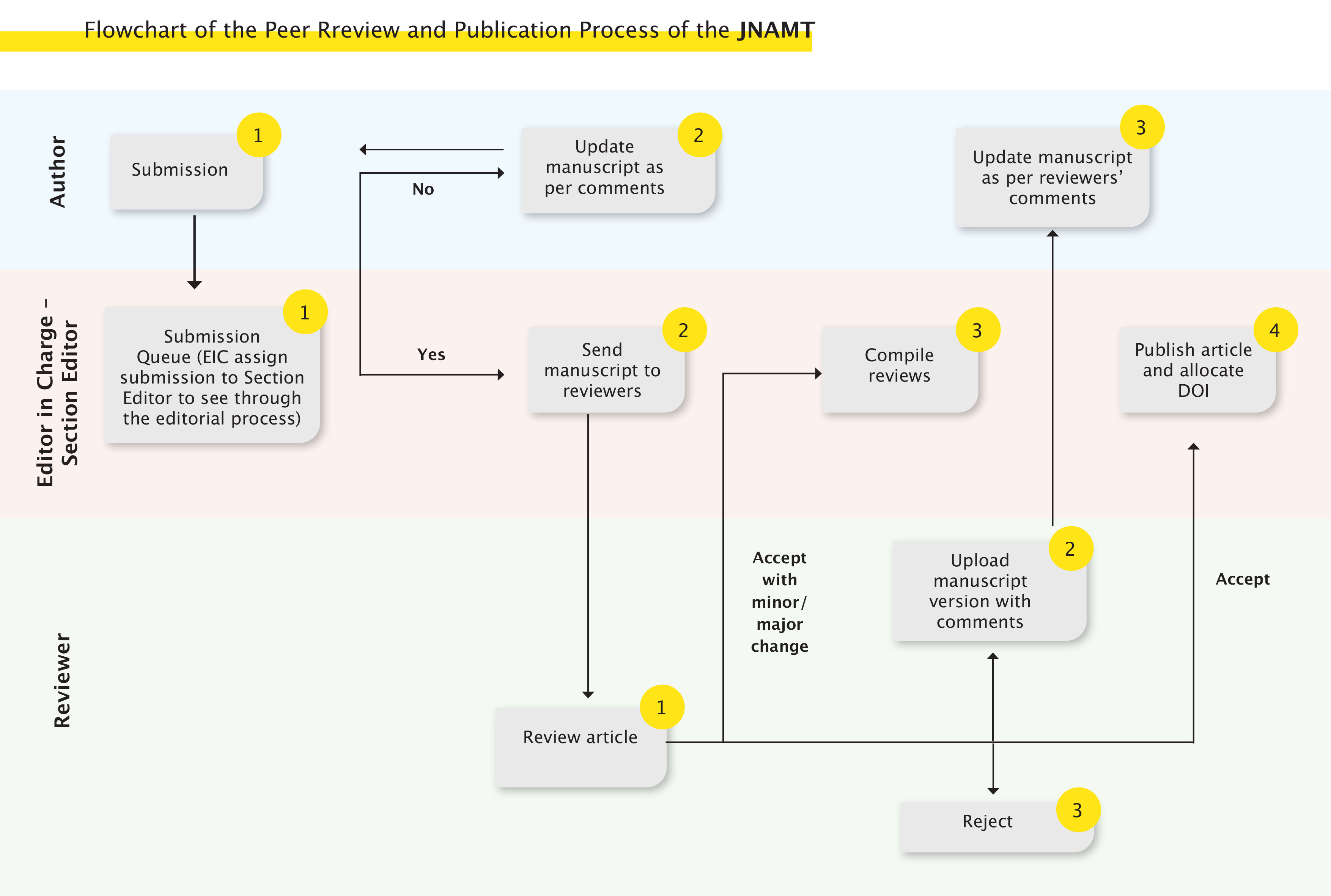
Article Writing Guidelines